
Training the world’s future quantum experts
11th August 2026
Article by Marzena Lapka
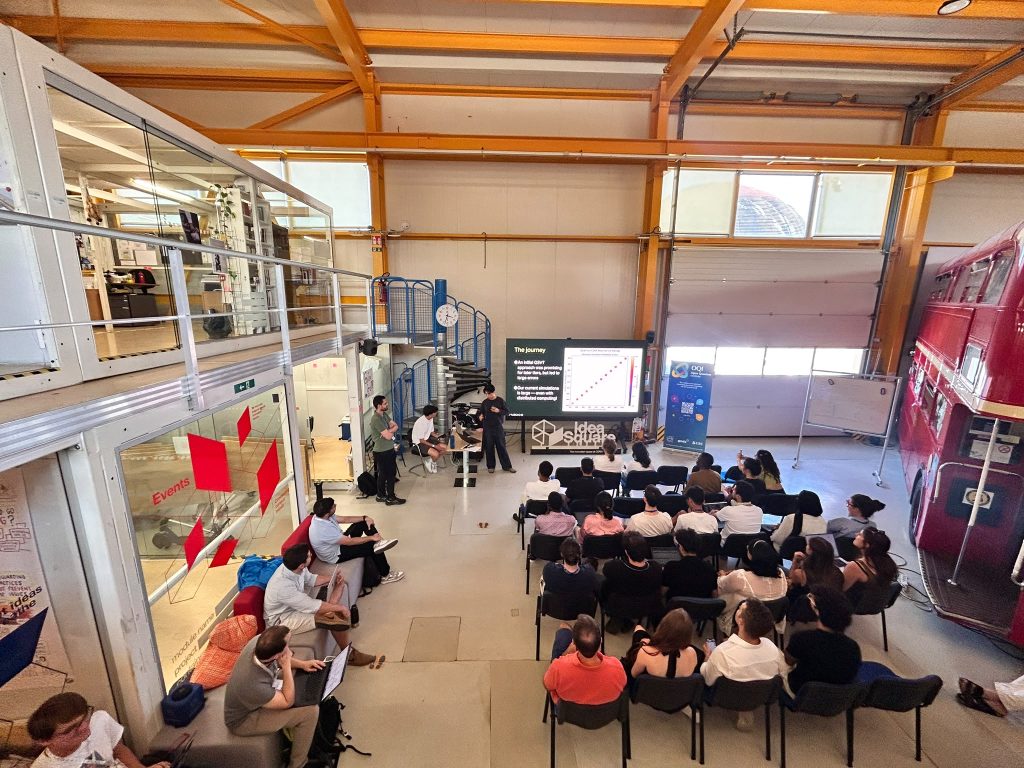
The Quantum Materials Hackathon 2026 was hosted at CERN IdeaSquare, an innovation space at CERN. (Photo: Henry Ryder)
From 10 to 12 July 2026, the Quantum Materials Hackathon brought together 34 students of over 30 nationalities for 48 hours of hands-on work. The students used quantum computing hardware and simulators to tackle real-world problems using quantum materials science, guided by mentors from industry and the research community.
Hosted at CERN IdeaSquare, the event was a joint effort of CERN (the Stakeholder Engagement group, the Quantum Technology Initiative (QTI) and CERN openlab), the Open Quantum Institute (OQI), Quantum4Purpose and Sparkboard.
Building quantum expertise across the world
Each year, CERN’s summer student programme brings students from across the world to Geneva, including participants from underserved geographies. The hackathon was designed to take full advantage of this exceptional diversity of young talent on site. It brought together CERN summer students and others from Swiss universities, including EPFL, ETH Zurich, and the University of Basel, for an intensive weekend of collaboration and exchange between talent from academia and industry.
This hackathon exemplifies the tremendous potential of such events as innovative educational tools. By providing hands-on experience with real-world problems and access to cutting-edge technology, hackathons offer a unique opportunity for participants to develop new skills and collaborate with peers from diverse backgrounds. The intensive format allows for rapid learning and progress, enabling participants to achieve in a weekend what might otherwise take weeks.
“Quantum hackathons enable the next generation of leaders to apply quantum computing to the SDGs in order to solve problems in clean energy, health, and food security that classical computing alone cannot address,” said Julia Thiele, EMEA Business Development and Go-To-Market Strategy for Quantum Computing at AWS and an OQI Advisory Committee member. “Access to quantum hardware exists through services like Amazon Braket, but what is needed now is a generation trained to use it. Hackathons deliver that.”
Why quantum materials?
Quantum materials display unique and sometimes unusual properties arising from the laws of quantum mechanics, with graphene being a well-known example. Their design and modelling are considered by many to be one of the areas in which quantum computing is most likely to show an advantage over classical approaches, which made them a natural focus for the event. The choice also reflects the strength of the regional ecosystem: Geneva and the wider region host a dense network of materials science expertise, in academia and in industry, from composite materials to coatings.
For CERN, the study of quantum materials is of particular importance, as many of the technologies used in particle accelerators and detectors, such as superconducting magnets and sensors, rely on their unique properties. Advancing the understanding of these materials could lead to significant improvements to CERN’s scientific instruments. Quantum technologies also play a significant role beyond the Laboratory, for example in the fields of clean energy, health, food security and the responsible use of natural resources like lithium and cobalt.
Challenges rooted in real problems
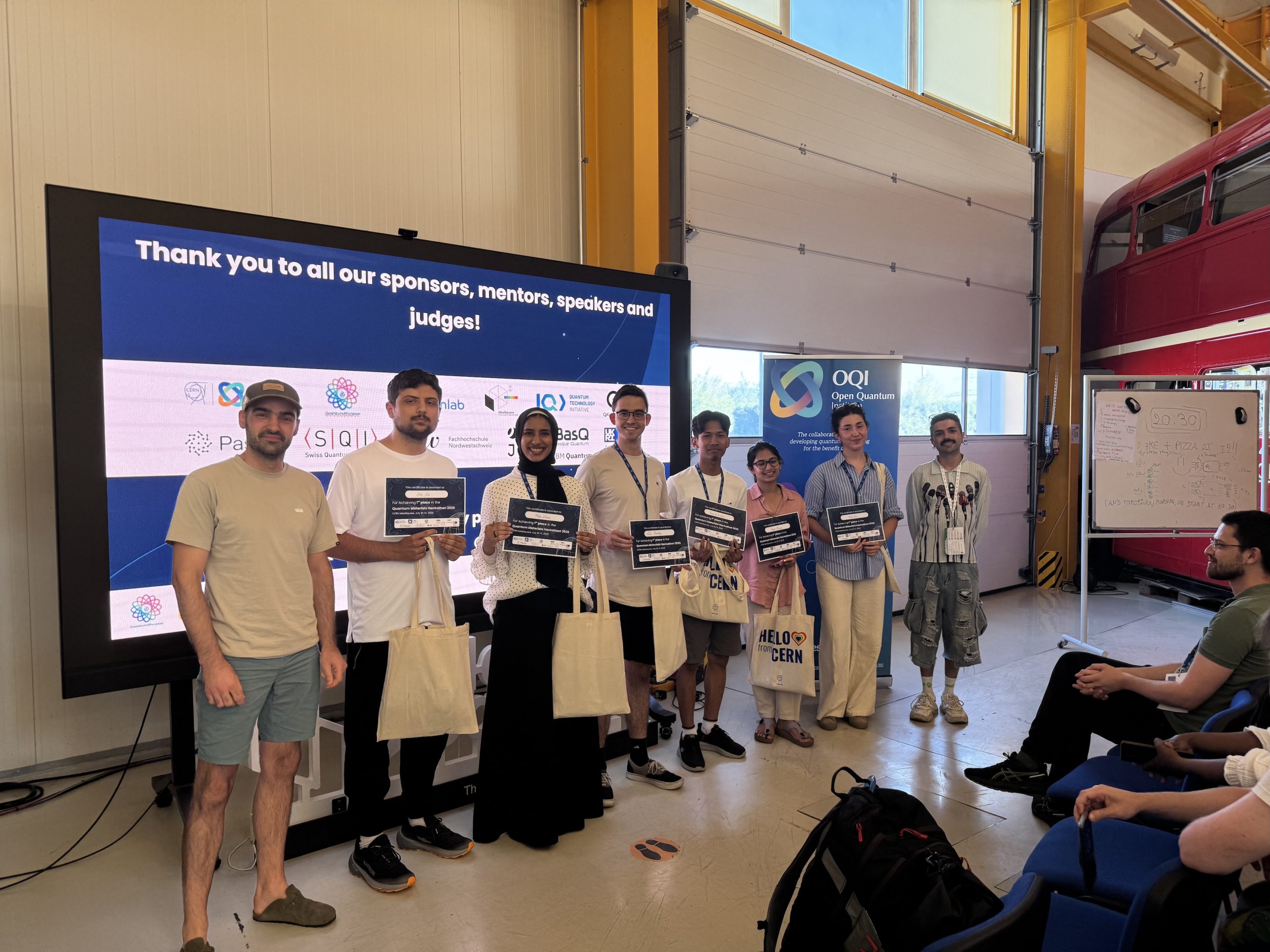
CERN Quantum Materials Hackathon 2026 winning team. (Photo: Martin Gastal)
Each team took on a challenge proposed by an industry or research partners, tackling questions that reflect genuine bottlenecks in materials research today and exploring how quantum technologies can contribute to the UN Sustainable Development Goals (SDGs). The problems came from Pasqal, JIJ, Basque Quantum (BasQ), the University of Applied Sciences and Arts Northwestern Switzerland (FHNW) and the UK’s Science and Technology Facilities Council (STFC) – as well as two challenges from CERN’s QTI, on superconducting materials and on quantum dots for solar energy harvesting.
Teams explored how quantum computing could support the search for materials that carry electricity with minimal losses, relevant to more efficient power grids and electronics; how solar technologies could move away from scarce or toxic components; how new computational methods could shorten the early stages of pharmaceutical development; and how quantum simulation could help researchers study materials whose behaviour classical methods struggle to capture.
Hands-on experience with cutting-edge quantum hardware
Access to IBM cloud quantum computing hardware provided by our partners BasQ and Pasqal’s latest state-of-the-art quantum simulators, along with dedicated pre-hackathon training and a mentor embedded with each team from start to finish, set this edition apart. For many participants, it was their first time running code on a real quantum computer.
“The hackathon was an incredible experience,” said Elliot Amponsah, a student from the Kwame Nkrumah University of Science and Technology (KNUST) in Ghana. “We were trying to predict how well certain drugs dissolve using a very small dataset. Running our models on real quantum machines allowed us to see how the algorithms handle real-world noise.”
At the end, every team delivered a solid final presentation with concrete results to show – work that did not go unnoticed by a judging panel drawn from across the quantum research community and industry, and that will open doors to internships for some participants.
The skills and connections gained during this intensive weekend will undoubtedly prove valuable to participants as they move forward in their careers.
The ambition for the next edition is to grow the network of industry partners to create more opportunities for young people entering the field, developing quantum expertise for the benefit of all.
Extended thanks go to a diverse ecosystem of supporters, such as mentors from Pasqal, CERN’s QTI, BasQ, FHNW and STFC UKRI, who supported the teams from start to finish; the judging panel, with representatives from CERN/OQI, QAI Ventures, AWS, IBM Quantum, Pasqal; the speakers from the University of Geneva and JIJ; and the generous sponsors Pasqal and the Swiss Quantum Initiative (SQI).