
Quantum Applications Framework
The OQI Quantum Application Framework provides practical guidelines and a methodology to help the global community develop impactful quantum computing use cases addressing global challenges. Validated by leading quantum hubs and organisations, the framework establishes a shared language and criteria for developing quantum applications aligned with the SDGs.
OQI is fostering a global community of practice dedicated to exploring potential quantum solutions for real-world problems. Together with OQI, they are contributing to the UN agenda while preparing for when quantum computers will be available at scale. In this context, OQI focuses on demonstrating the applicability of existing quantum methods, rather than discovering new ones.
The most relevant approaches for quantum computing applications towards the SDGs, and the ones used by our supported use cases, can be grouped under the following categories:

Quantum simulation
Used for modelling the quantum nature of systems, such as molecules, atoms or materials, at nanoscale level or lower, where the rules of quantum mechanics apply.
Example of quantum simulation: Calculating energies of molecular structures and using this information to better understand how drugs are metabolised in the body.
Machine Learning
Machine LearningUsed to analyse patterns from small and complex datasets and make predictions of outcomes or generate new data.
Example of machine learning: Predicting health conditions through earlier identification of unusual patterns in medical data.

Optimisation
OptimisationUsed to minimise or maximise a quantity in order to approach the best possible outcomes, while taking into account a large and complex set of options and constraints.
Example of optimisation: the travelling salesman problem – which tries to find the most efficient route through a set of locations, using the shortest route that visits each place once before returning to the starting point. In this example, the quantity would be the total distance travelled in between each point visited.
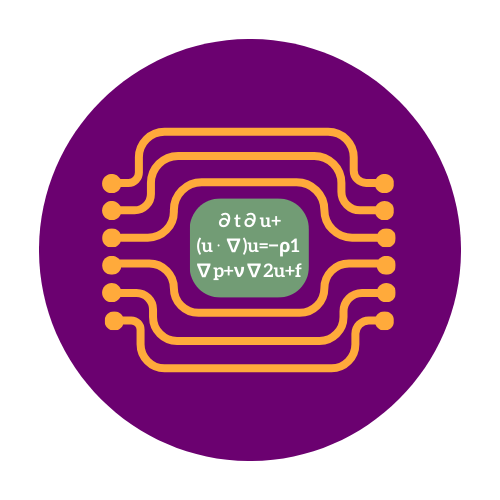
Linear Systems of Equations and Partial Differential Equations (PDEs)
Linear Systems of Equations and Partial Differential Equations (PDEs)Used to understand how the dynamics of systems evolve over time and space.
Example of linear systems of equations and PDEs: modelling fluid dynamics to improve weather forecasting or modelling air turbulence for planes, to reduce air friction as much as possible.
OQI's framework: quantum computing applications for the SDGs
The OQI Applications Framework is built on four core aspects: multidisciplinarity, multi-phase development, equitable access, and pathway to impact. An outline of the Framework can be found below.
Multidisciplinarity
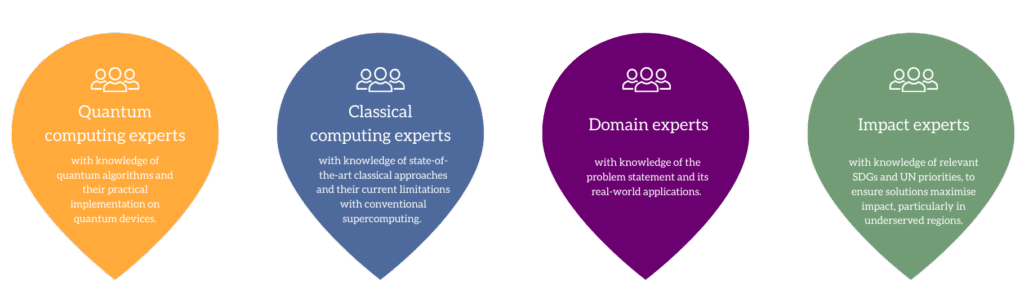
OQI supports teams of multidisciplinary backgrounds to work on use cases. Each use case team is composed of:
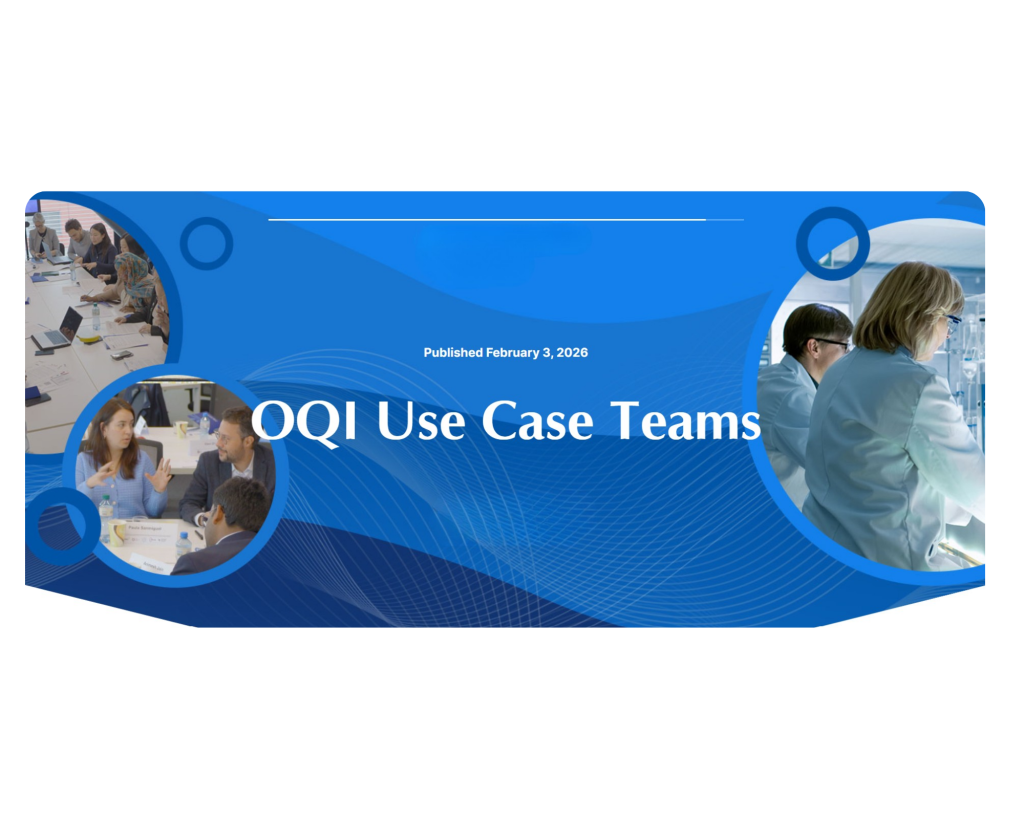
In collaboration with Algorithmiq and OQI, QPlayLearn has developed an interactive e-learning course – a starting point for exploring how to build responsible, robust and impactful quantum computing use cases that can benefit humanity.
This module introduces OQI’s quantum computing use case teams, offering insights into the OQI use case pipeline, as well as the development process, why it matters and how you can get involved. It features guided lessons alongside interactive exercises and games that walk you through the process of how to build an SDG-focused use case to address a real-world challenge, outlining OQI’s methodology for developing use cases from ideation to proof of concept and opportunities for how people can get involved.
Access and inclusion
The framework is designed to widen participation on a global scale, in particular from quantum-underserved regions. OQI provides mentorship, learning resources and, if resources permit, selected use cases may receive free credits for testing and implementation of their proof of concepts on early quantum simulators and quantum processors via OQI’s partners’ cloud platforms – enabling teams to develop and test their proof of concepts even if they do not have local infrastructure.
Pathway to impact
OQI has developed an impact anticipation framework to articulate, and tool to anticipate the benefits for the population, planet and prosperity of the use cases for the people and the planet once deployed in the real-world.
Based on the Theory of Change, it maps out the pathway to long-term impact of each use case, identifying who benefits, under which conditions, and how to manage and anticipate any risks and unintended consequences.
Multiphase
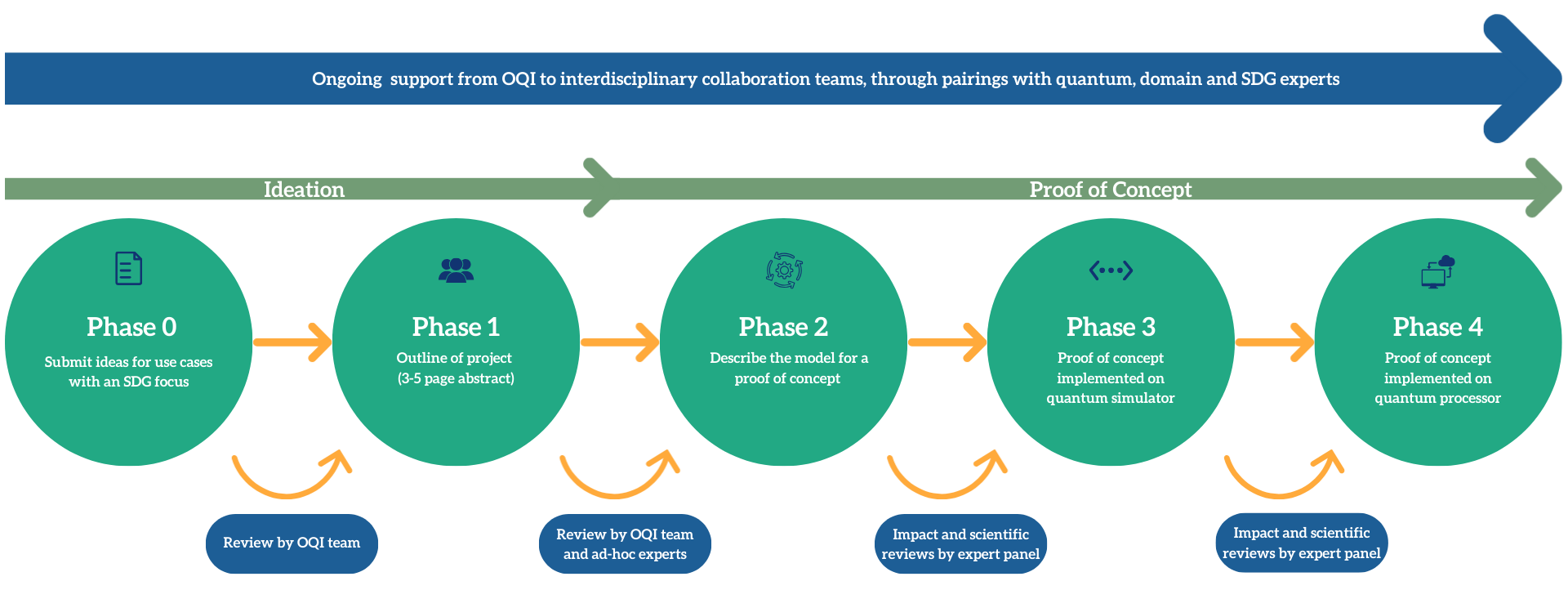
The use case development phases progress from ideation to a proof of concept, with OQI providing technical and project management support.
OQI support spans over several phases of use case development over an 18 month timeline, providing technical and project management support to progress from ideation to a proof of concept.

Ideation
Phase 0
This is the starting point and main filtering pass for identifying relevant SDG challenges that could be addressed by quantum computing. OQI is building a large repository of use case ideas to further inspire and encourage participation in the journey.
Phase 1
Refinement of selected ideas, with OQI support, is successfully done with the contribution of diverse expertise (quantum computing, domain experts and SDG experts from UN or large NGOs), with the aim to convert ideas into more tangible approaches. In this phase, use case teams start to outline the typical classical approaches used, where a quantum computing solution could help, and what kind of impact a faster or better solution would mean.

Proof of concept
Phase 2
Development of a proof of concept with OQI support. This leads to the preparation of a full proposal, using the OQI full proposal template, which expands on the approach proposed in phase 1 to detail their methodological and algorithmic approach. At the end of phase 2, an evaluation, with scientific and impact panels, is performed.
In the context of OQI:
- The problem must be linked to the UN Sustainable Development Goals (SDGs).
- A proof of concept is a demonstration that quantum computing could solve a problem, either on current or future quantum hardware devices.
- The quantum solution should aim to show an advantage over classical state of the art algorithms (at least once implemented on fault-tolerant quantum computers, which are powerful and reliable enough to run large-scale calculations and error correction).
Phase 3
If a small-scale proof of concept is implementable on today’s quantum simulators accessible on the cloud and could lead to meaningful results, then this phase is designed to test and optimise the potential quantum computing solutions.
Phase 4
If Phase 3 is satisfactory, implementation on suitable cloud-available quantum processors, depending on the type and size of the proof of concepts, is then considered.
Selection and evaluation process of proof of concepts
To maintain scientific rigor and SDG-alignment, the OQI Scientific and Impact Panels assess the quality of the use case proof of concept proposals.
These evaluations are a crucial step to guide the selection of use cases to progress into advanced phases that would lead to implementation on quantum simulators and hardware devices.
The main evaluation criteria are:



We are grateful to all the experts for their valuable contributions to the evaluation panels and to the OQI pilot phase:
Scientific Panel
- Elica Kyoseva (NVIDIA)
- Barry Sanders (University of Calgary)
- Brad Lackey (Microsoft)
- Ivano Tavernelli (IBM)
- Clément Javerzac (University of Applied Sciences Northwestern Switzerland (FHNW))
- Ryan Babbush (Google)
- Olivier Ezratty (Quantum Energy Initiative, Author)
- Markus Reiher (ETH Zurich)
- Albert Werner (University of Copenhagen)
- Daniel Stilck Franca (University of Copenhagen)
- Koen Leijnse (Quantum Delta Netherlands (QDNL))
- Will Zeng (Unitary Foundation)
- Yacine Haddad (CERN)
Impact Panel
- Deborah Nas (Quantum Delta Netherlands (QDNL)
- Mira Wolf-Bauwens (IBM, now GESDA)
- Kyriacos Koupparis (World Food Program (WFP))
- Stela Mocan (World Bank Group)
- Gillian Makamara (International Telecommunication Union (ITU))
- Davide Fanciulli (Beyond Lab)
- Julia Cramer (Quantum Delta Netherlands (QDNL))
- Damien Somé (Global Antibiotic Research and Development Partnership (GARDP))
- Natasha Oughton (UK’s National Quantum Computing Center (NQCC))
- Yvan Serret (PwC)
- Diego Estrada (PwC)
- Amal Kasry (UNESCO)