
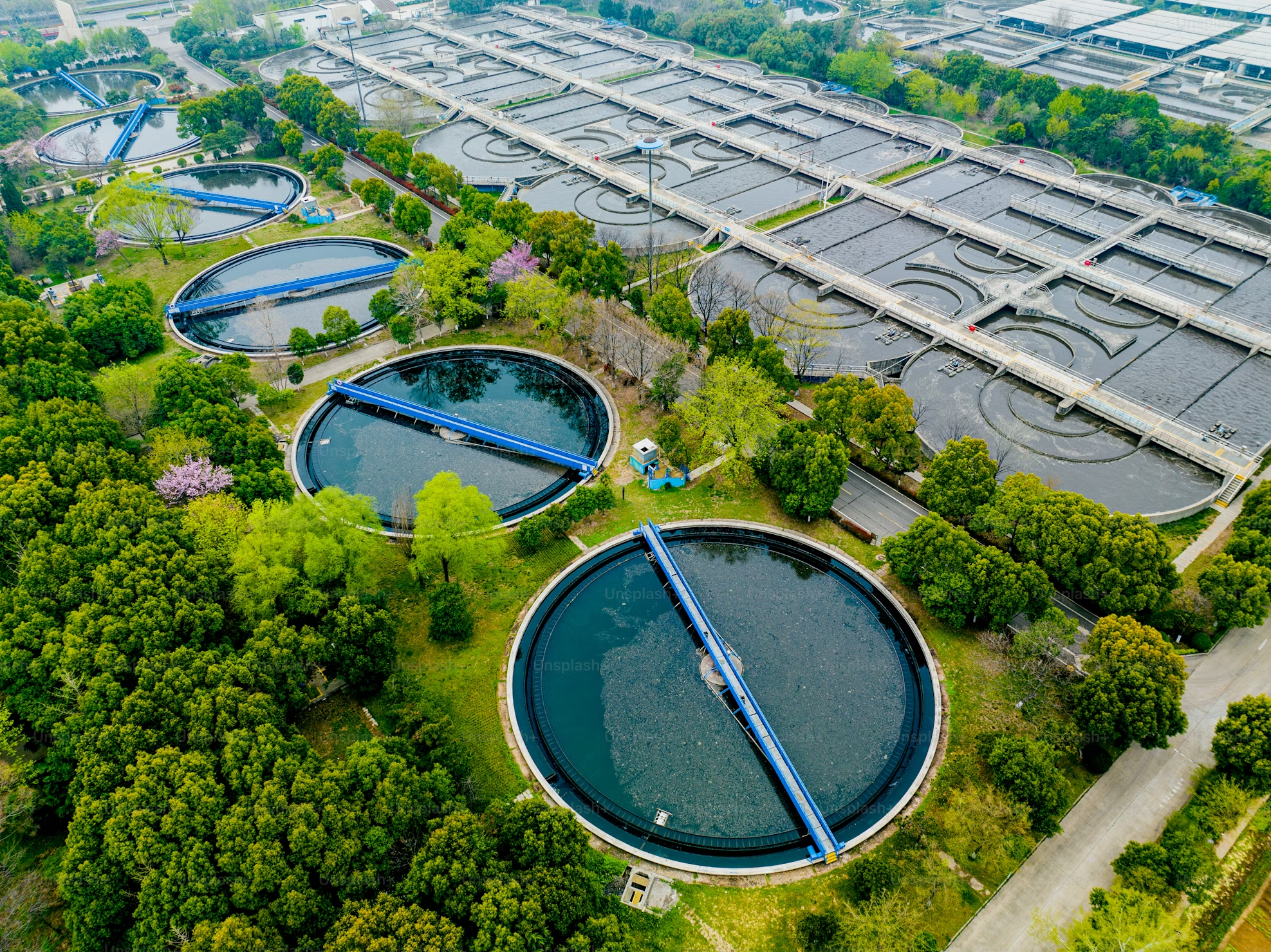
Materials for Sustainable Water Desalination
Quantum optimisation solution to efficiently layout of turbines in a wind farm and maximise the power produced.
Owner

Status
Phase 0 – Ideation
Quantum Approach

Quantum Simulation
SDGs

Contributors
New York University Abu Dhabi (NYUAD)
Origins of Contributors

Impact/context
Water purification and desalination are critical technologies to address the growing demand for clean water, particularly in arid regions. Yet water desalination is an energy-intensive process which exacerbates both water scarcity and water pollution. In fact, desalination produces concentrated brine that, when discharged, poses significant environmental risks to ecosystems and causes long-term ecological degradation. This brine is not only rich in salts but also contains organic contaminants, heavy metals, and other toxic substances that are challenging to treat. There is however a rising global reliance on desalination, where the volume of brine and its associated pollutants continues to grow, intensifying the strain on environmental systems. These persistent pollutants resist conventional treatment methods and current technologies often fail to comprehensively address these issues while maintaining environmental sustainability.
How quantum could help
The integration of photocatalytic technologies into desalination processes has the potential to significantly reduce the energy costs associated with membrane fouling and brine treatment. However, the discovery and optimization of Covalent Organic Frameworks (COFs)-based photocatalysts are significantly constrained by the expansive and complex chemical and structural design space. The infinite combinations of monomers, linkers, and functional groups create an overwhelming array of possibilities. Traditional experimental approaches, even with high-throughput robotic synthesisers, are insufficient to explore this immense space comprehensively and therefore computational methods are used to model the photocatalytic process.
As many of these steps in the process are quantum chemistry related problems, it is natural to consider tackling them with advanced quantum algorithms, such as the Harrow-Hassidim-Lloyd (HHL) algorithm, the Variational Quantum Eigensolver (VQE), and quantum machine learning (QML), which respectively could improve the modeling of the optimisation of redox reactions, bandgap engineering, and overall COFs as advanced photocatalysts for desalination processes.
Such advancements would address both economic and environmental challenges associated with conventional water treatment processes, by reducing energy costs and minimising hazardous by-products.
References
University of Bristol, MIT(Quantum Algorithm for Linear Systems of Equations) (United Kingdom, USA)