
Three years on, the Open Quantum Institute’s role has never been more critical
19th June 2026
Article by Marzena Lapka
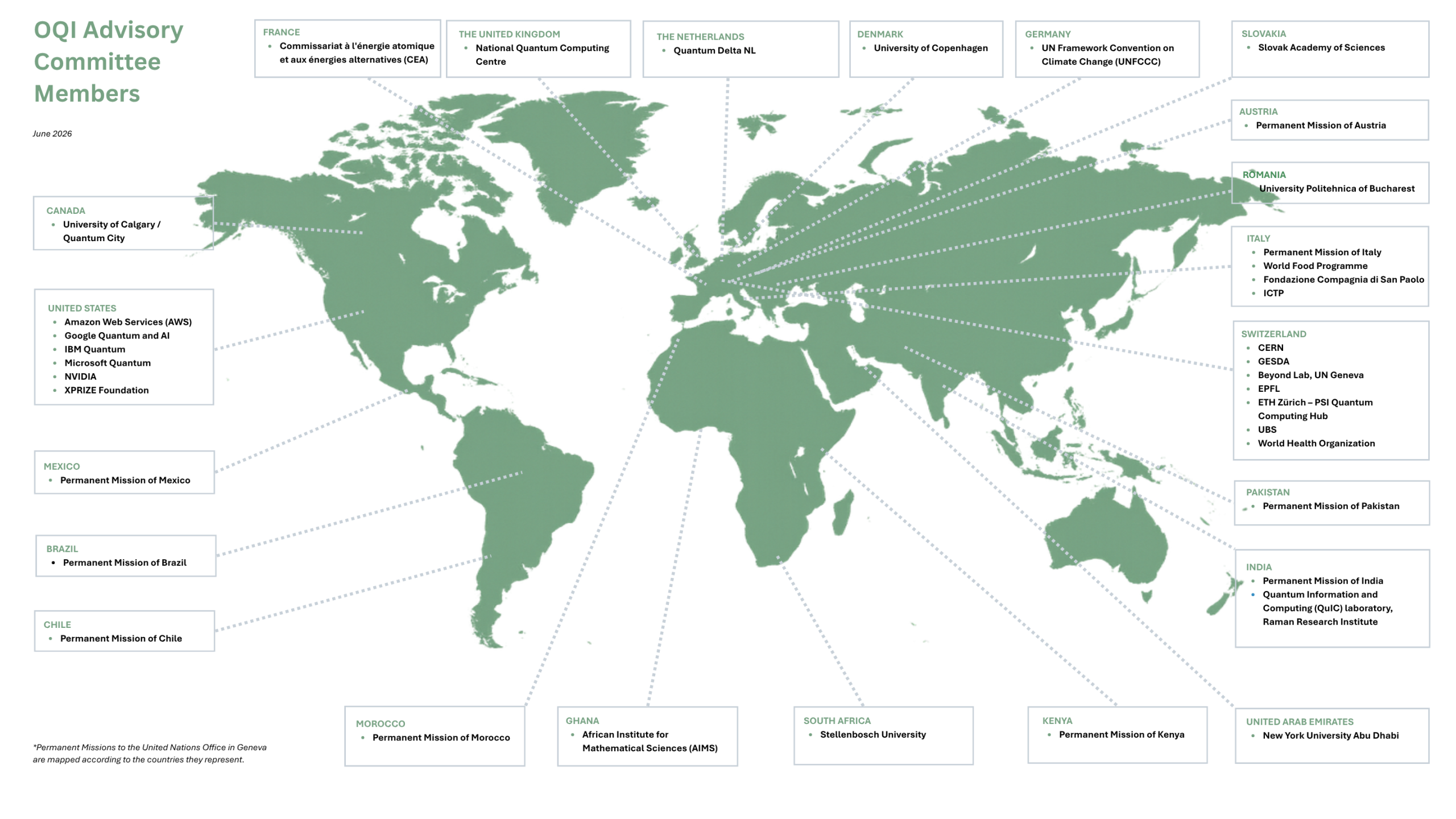
A map showing the OQI Advisory Committee members’ distribution. June 2026
As quantum computing moves closer to technological maturity, the need for trusted institutions capable of connecting science, diplomacy and society is growing rapidly. Nearly three years after its launch, the Open Quantum Institute (OQI) has demonstrated that it can play this role effectively. The institute’s Advisory Committee recently endorsed the positive evaluation of the pilot phase and reaffirmed OQI’s growing importance in the years ahead.
Three messages emerged clearly:
OQI pilot phase exceeded its expectations so far
Across all four pillars of OQI’s work – use case exploration, access to quantum computing resources, capacity building, and quantum diplomacy – the pilot has met, and in some cases exceeded, every ambition set at its inception. This is the result of years of work supported by an extraordinary community. The full picture, with complete data, will be released in the evaluation report this September.
Uniqueness of the OQI mission
Across the Advisory Committee, one conclusion emerged without dissent: no other organisation combines scientific rigour, geopolitical neutrality, focus on the UN Sustainable Development Goals, and genuine global multi-stakeholder convening in the way OQI does. That combination is precious, and its value is growing.
OQI’s role grows more critical as quantum computing matures
The Advisory Committee left no room for doubt: OQI has delivered real results, and its role will become even more critical as quantum computing approaches technological maturity. Recent advances across the quantum ecosystem have accelerated expectations for when practical quantum applications may become a reality. Since the beginning of 2026, estimates for the arrival of useful quantum applications have consistently moved closer. As the technology matures, the community OQI has built, the methodology it has developed, and the diplomatic relationships it has forged will become increasingly indispensable. The Advisory Committee’s support for the continuation of the institute reflects this conviction: the foundations are in place, the global ecosystem is growing, and OQI is uniquely positioned to help ensure that quantum computing technologies deliver benefits for society.
Looking ahead, the Advisory Committee endorsed a clear set of strategic orientations for OQI’s next phase: continuing its four activity pillars, expanding its scope to quantum-adjacent AI, further regionalising programmes to deepen global reach, and strengthening pathways towards the real-world deployment of technology applications.
The confidence to set such ambitions is rooted in the strength of the ecosystem OQI has built, and in the exceptional expertise and institutional commitment that has supported it from the start. Among them are the Advisory Committee members, who have generously shared their time, expertise and networks. CERN provided OQI with a home unlike any other: a place defined by scientific excellence, international collaboration and neutrality. GESDA‘s vision of anticipatory science diplomacy inspired the institute from the outset. Underpinning it all, UBS‘s funding of the pilot phase made these first three years possible.